
Entrez dans n'importe quelle épicerie et vous verrez des dizaines de bouteilles portant la mention « huile d'olive ».
Elles se ressemblent peut-être, mais à l'intérieur de la bouteille, les différences peuvent être importantes.
L'univers de l'huile d'olive comprend de nombreuses qualités, origines, méthodes de production et profils de saveur. Comprendre ces différences vous aide à choisir une huile d'olive qui offre plus de goût, plus de qualité et une véritable expérience méditerranéenne.
L'huile d'olive extra vierge grecque, surtout celle des régions oléicoles traditionnelles comme la Messinie, représente des siècles de savoir-faire, une culture attentive et la volonté de préserver le caractère naturel de l'olive.
Alors, qu'est-ce qui distingue vraiment l'huile d'olive extra vierge grecque ?
Comprendre les catégories d'huile d'olive
Avant de comparer l'huile d'olive extra vierge grecque à l'huile d'olive ordinaire, il faut savoir que « l'huile d'olive » n'est pas un produit unique.
Il existe différentes catégories selon les méthodes de production et la qualité.
Huile d'olive extra vierge (EVOO)
L'huile d'olive extra vierge est la catégorie de la plus haute qualité.
Elle est obtenue par des procédés mécaniques, sans traitement chimique, et doit respecter des normes de qualité strictes.
Une EVOO de grande qualité offre généralement :
- Des arômes frais d'olive
- Une amertume équilibrée
- Une finale poivrée
- Des antioxydants naturels
- Des saveurs complexes
Son goût reflète la variété d'olive, la région, le climat et les méthodes de récolte.
Huile d'olive ordinaire
Beaucoup d'huiles d'olive courantes en supermarché sont des huiles raffinées ou des mélanges.
Elles subissent souvent des traitements supplémentaires pour éliminer les saveurs indésirables et améliorer leur stabilité.
Ces traitements peuvent donner :
- Un goût plus neutre
- Moins d'arômes
- Moins de caractéristiques naturelles qu'une huile d'olive extra vierge haut de gamme
Si l'huile d'olive ordinaire peut servir en cuisine, elle n'offre pas la même expérience sensorielle qu'une huile d'olive extra vierge fraîche et authentique.
1. L'huile d'olive grecque commence par des variétés d'olives exceptionnelles
L'une des plus grandes différences entre l'huile d'olive grecque et beaucoup d'huiles commerciales tient à la variété d'olive.
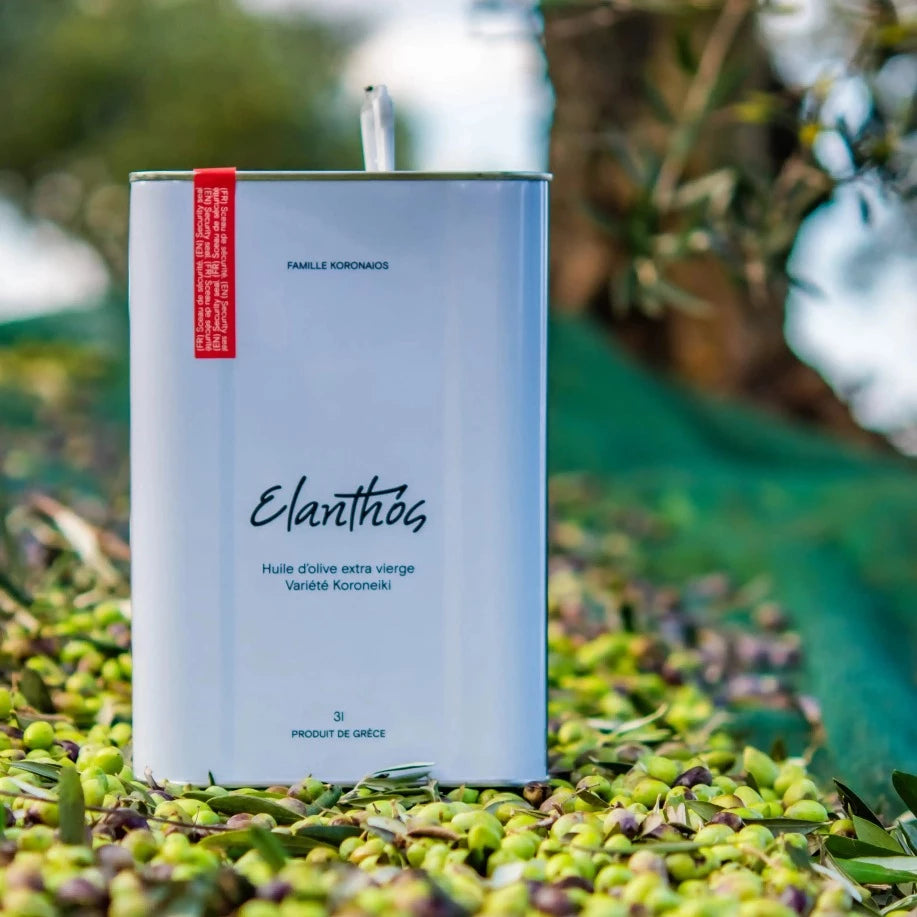
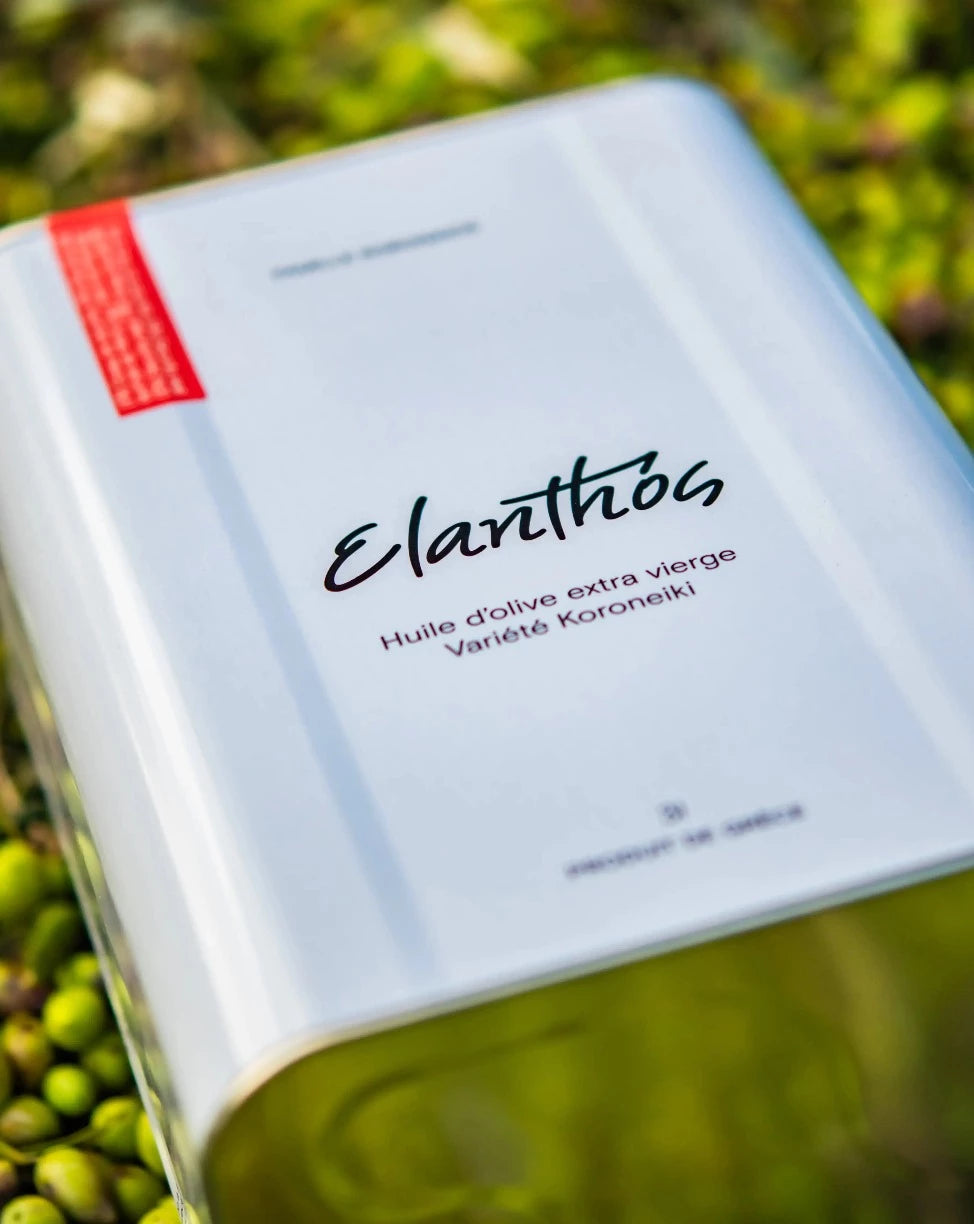
ELANTHÓS est produite à partir de l'olive Koroneiki.
La Koroneiki est l'une des variétés les plus célèbres de Grèce, cultivée depuis des siècles.
Bien que l'olive soit petite, elle donne une huile reconnue pour :
- Ses arômes verts et frais
- Ses notes fruitées
- Sa douce amertume
- Sa finale poivrée
- Son caractère méditerranéen distinctif
La variété d'olive est la base de la saveur finale.
Comme les cépages influencent le vin, les variétés d'olives influencent l'huile d'olive.
2. L'origine compte : l'importance du terroir grec
Le mot « terroir » décrit la façon dont, dans une région :
- Le climat
- Le sol
- La géographie
- Les traditions agricoles
influencent un produit agricole.
La Messinie, en Grèce, offre des conditions idéales pour la culture de l'olivier.
Le soleil méditerranéen, le climat côtier et des générations d'expérience oléicole contribuent aux qualités uniques de l'huile d'olive grecque.
Une bouteille d'huile d'olive extra vierge grecque porte l'identité de la terre où les olives ont poussé.
3. Le moment de la récolte crée la fraîcheur
Une huile d'olive haut de gamme commence par la récolte.
Le moment de la récolte influence :
- La saveur
- L'arôme
- La couleur
- Les composés naturels
Des récoltes précoces et bien gérées donnent souvent des huiles aux saveurs éclatantes et au caractère plus marqué.
Comme l'huile d'olive est un produit agricole frais, la saison de récolte est importante.
Contrairement aux produits qui s'améliorent avec le temps, l'huile d'olive se savoure de préférence lorsqu'elle est fraîche.
4. Les méthodes de production préservent la saveur naturelle
Les producteurs traditionnels d'huile d'olive grecque s'attachent à protéger les qualités naturelles de l'olive.
Le processus comprend :
- La récolte des olives
- Le nettoyage des olives
- Le broyage des olives
- L'extraction de l'huile
- La filtration et l'entreposage de l'huile
- La mise en bouteille
Chaque étape influence le produit final.
Les petits producteurs gardent souvent un meilleur contrôle de la qualité, car chaque récolte reçoit une attention particulière.
5. L'huile d'olive grecque a un profil de saveur unique
Une huile d'olive extra vierge grecque haut de gamme n'est pas simplement « grasse ».
Elle a de la personnalité.
ELANTHÓS offre des caractéristiques souvent associées à l'huile d'olive Koroneiki :
- Un arôme frais et herbacé
- Une saveur d'olive douce
- Une amertume équilibrée
- Une agréable finale poivrée
Cette sensation poivrée en fin de bouche est souvent liée à des composés naturellement présents dans une huile d'olive de qualité.
Pour bien des amateurs, c'est un signe de fraîcheur et de caractère.
6. L'huile d'olive extra vierge grecque, fondement de la cuisine méditerranéenne
Dans la cuisine grecque, l'huile d'olive n'est pas qu'un simple ingrédient de cuisson.
Elle fait partie intégrante du repas.
Un plat simple peut devenir exceptionnel grâce à une huile d'olive de qualité :
Salade grecque
Des tomates fraîches, du concombre, de la feta, des olives, de l'origan et un généreux filet d'EVOO.
Légumes grillés
Des légumes rôtis, terminés avec un filet d'huile d'olive, deviennent plus riches et plus savoureux.
Fruits de mer frais
Un filet d'huile sur du poisson grillé : une combinaison méditerranéenne classique.
Pain trempé
L'une des façons les plus simples d'apprécier une huile d'olive haut de gamme.
Parfois, la meilleure expérience ne demande rien de plus qu'un bon pain et une EVOO exceptionnelle.
Pourquoi choisir une authentique huile d'olive grecque chez VELI ?
Chez VELI Importations épicuriennes, notre objectif est de faire découvrir aux Canadiens d'authentiques produits grecs, synonymes de tradition et de qualité.
ELANTHÓS provient de Filiatra, en Messinie (Grèce), de la famille Koronaios.
Elle représente :
✓ Le patrimoine grec
✓ Une production de petite récolte
✓ Des olives Koroneiki
✓ Une authentique saveur méditerranéenne
✓ Un lien avec des générations de tradition oléicole
En choisissant ELANTHÓS, vous n'achetez pas simplement de l'huile d'olive.
Vous apportez un morceau de la Grèce dans votre cuisine.
Questions fréquentes
L'huile d'olive grecque est-elle meilleure que l'huile d'olive ordinaire ?
L'huile d'olive extra vierge grecque est appréciée pour sa saveur, ses méthodes de production, ses variétés d'olives et son lien avec les régions oléicoles traditionnelles. La qualité dépend du producteur, de la fraîcheur et des pratiques de récolte.
Pourquoi l'huile d'olive grecque est-elle considérée de grande qualité ?
La Grèce cultive l'olivier depuis des milliers d'années. Les huiles d'olive grecques haut de gamme profitent souvent de méthodes agricoles traditionnelles, de variétés reconnues comme la Koroneiki et de conditions de culture méditerranéennes idéales.
Qu'est-ce qui rend l'huile d'olive Koroneiki spéciale ?
Les olives Koroneiki donnent une huile aromatique aux notes fruitées, à l'amertume équilibrée et à la finale poivrée.
L'huile d'olive extra vierge a-t-elle un goût différent ?
Oui. Une huile d'olive extra vierge de grande qualité peut présenter des arômes et des saveurs marqués : herbacés, fruités, herbeux et poivrés.
Puis-je cuisiner avec de l'huile d'olive extra vierge grecque ?
Oui. L'huile d'olive extra vierge grecque est polyvalente : salades, finition des plats, rôtis, sautés et cuisine de tous les jours.
En conclusion
La différence entre une huile d'olive ordinaire et une authentique huile d'olive extra vierge grecque tient aux détails :
La variété d'olive.
La terre.
La récolte.
La production.
Les gens derrière la bouteille.
ELANTHÓS représente la tradition de l'huile d'olive grecque : élaborée avec soin, partagée avec fierté et savourée autour de la table.